
Bookends: November
What I read last month
Good morning, readers. Reporting to you from Baltimore, where there is a very unpleasant sleety thing happening outside at the moment. My November was very trying, full of irritating and executive-function-requiring tasks, which is annoying any time of year but especially when you (me) just want to be under blankets and eating pumpkin-based desserts. I still did plenty of that, to be fair, but that may explain why I was perhaps a little hard to please with my reads this month.
Without further ado:
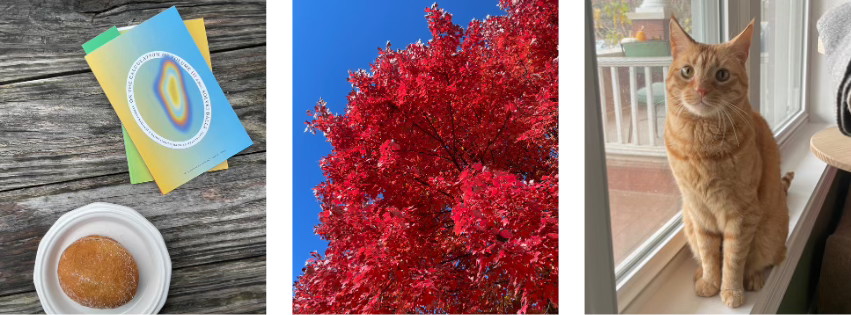
In the City, by Joan Silber
Silber’s 1986 novel, soon to be reissued by Hagfish Press, follows Pauline Samuels, a Jewish girl from Newark in the 1925, who graduates high school and is determined to make it in the big apple. She finds a job as a clerk and a room in a boardinghouse and soon falls in with a fashionable Washington Square set, who throw fun parties and hang out in smoky cafes and argue over books and politics. I was unfamiliar with Silber, and found an old copy of In the City at the library after hearing of the reissue, and Silber described as a real undersung writers’ writer of the late 20th century.
At times she thought now that she was waiting for the fundraiser to be over so that her time of breaking up with Dewey could begin. She had a sense of the current time not counting, really, and of something disagreeable being put off till later.
At other times it seemed to her that she was already living the way she was going to continue to live, that her present life with Dewey was permanent, that she had gotten settled without really knowing it. There were women like that —always a little surprised at the impractical nature of their own alliances —initiates of a knowledge improbable even to themselves; perhaps she had passed into that state.
I enjoyed In the City even if I didn’t quite love it; it’s a fun read, very sweet, although a good third of the book is taken up with a loser boyfriend Pauline should’ve dumped after one week instead of fifty (who can relate?), and I found myself skimming ahead waiting on that relationship to end. Passages like the above really evoke, for me, the sense of figuring out adulthood, of feeling wise and naive at the same time, of a timeless sense of how time and life move. Equal parts funny and silly and sad and a little pathetic, I’m glad I read this one.
Daphne du Maurier, by Margaret Forster
Other than that she had lived in Cornwall, I knew next to nothing about du Maurier. (My mother-in-law, who spends time in Cornwall also, lent me this book with the caveat that that was what she was most interested in.) I love Rebecca, and have read some of her short stories, but had actively avoided the rest of her bibliography; I had come to understand at some point that nothing lived up to Rebecca, and got the sense that any follow-up would be a disappointment. That decision was probably correct.
She had been so keen that the book should sell, and so conscious of her debt to her publisher, who had been lavish with expensive advertisements, that she had done something she had always vowed she never would: in August, on publication of Rebecca, she was a guest at a Foyle’s Literary Lunch. She agreed to let Victor persuade her on condition she did not have to speak, and sat in silence while other authors, Margery Allingham and Audrey Lucas among them, made speeches. She disliked the experience intensely and condemned her fellow authors quite savagely: “Women shouldn’t speak in public unless they are born with the gift, and damn few women are. And the efforts of Miss Allingham proved to me I am right!” She thought their speeches embarrassingly bad and the whole occasion an appalling waste of time.
On a personal level, I liked du Maurier less with every new thing I learned about her: a generational nepo-baby1, spoiled, rich, racist and homophobic and misogynistic (crying because you had daughters, neglecting them, and then doting on your baby boy? gtfoh) and deeply selfish to the point of narcissistic, obsessed with a house that she pointedly did not own and “merrily” described as so rat-infested it terrified her small children. Daphne was fond of her own invented slang and because the book (to its credit) quotes extensively from her own letters, the biography is riddled with tedious code, like “Venetian” for “lesbian.” On that note, her queerness and the choices she made around it are fascinating, especially hearing her describe both her fear and desire apparently candidly in her letters, but it’s such a small element of her story and not worth wading through the rest unless you’re much more of a du Maurier-head than I am. To Forster’s credit I think she did a great and very thorough (and decently fair) job, working closely with family sources; it was the subject more than the book itself I found unbearable.
Minor Figures, by Brandon Taylor
Wyeth is a black2, gay painter living in New York, paying the bills with assistant jobs at a gallery and an art restoration house. His work largely consists of black people painted into scenes modeled after frames from cinema, from directors like Bergman. Wyeth is concerned with light and form and the body, and was extremely dismayed when one of these paintings goes viral after George Floyd’s murder—he has failed to do something greater than a “dead black boy painting,” or accidentally fallen into one. Now he’s trying to move beyond that into something “real” when he meets Keating, a beautiful blond ex-priest at a bar. Their romance is tender, easily bruised, and erotic. In the meantime he rails against “ugly” art (and people and scenes and film). Ugly, as in done by people who traded on their identities, who expected the aesthetics of their art to matter less than the biography of its maker.
Could one achieve that objectification of the black figure without recapitulating violent or hegemonic ideas or themes or tropes? Was any painting of a black person a violence? Could there ever be a painting of a black figure that was not reenacting some gross historical harm?
Was the very desire to create a black figure outside of history itself a reflex against gross historical harm? Did white people have that same baggage? When Wyeth had painted white men, he did not think of that.
When he looked at white men, he had absolutely no qualms about objectifying them. He did not fret over the delicacy of their souls or the possibility of their figure being a site of gross historical harm. He was mostly concerned with the play of light on their shoulders or in their eyes. When he saw them, he did not, for example, think of the Thirty Years’ War, though perhaps he should have. Maybe his paintings would have been better if he’d thought of that.
It was interesting, this idea of painting a white man with the same set of considerations of violence, history, and/or objectification, which were usually imported into the figuration of black people. That, Wyeth thought, was true negro figuration. Not the depicting of black figures, but that any figure depicted with the set of considerations normally reserved for the black figure could itself be made into a black figure.
The novel has been praised for its verisimilitude, and moves slowly through a New York summer, time punctuated by long runs in Central Park and ice cream and cigarettes. If you live in or love NYC I think you might appreciate this more; I happily recounted to Nathan a passage where Wyeth visits a bookstore we’ve visited. Beneath its day-to-day accountings, however, I found it very didactic. Taylor has often advocated for the necessity of fiction having a moral weight or center, real stakes, which I admire in theory. In practice, I felt disengaged during tense conversations about art and Art. Contemporary black artists, such as Amy Sherald, catch quite a few strays, a bolder move than most novels would take.
Perhaps the book’s hyper self-awareness is reflective, a mirror of the self-seriousness and faux-depth of the Art Scene and what it means to gaze or Gaze. Some conversations feel thoughtful while in the next paragraph I would actually cringe, like during an uncomfortably sarcastic aside about COVID scolds on the internet (or really any complaint about the internet), or when Wyeth (twice!) uses the phrase atheist money theology, a phrase I could not define for you but unfortunately have to admit I recognize from the author’s twitter. In fact several interior monologues feel lifted from social media wholesale if not even Taylor’s earlier work, such as a frequent working-class bemusement at the trappings of the “media class” that at this point feels uncomfortably disingenuous. All of this is maybe an argument for me to log off more than anything else.
The Bog Queen, by Anna North
Agnes, a Bones-esque forensic scientist, is working on a post-doc in England when she’s tasked with examining a 2,000-year-old body discovered in a bog. Local environmentalists want to preserve the bog’s ecosystem while the landowner (a peat harvesting operation) wants to sell off for development as quickly as possible, while Agnes struggles to uncover the body’s secrets before time runs out. The story is told in two storylines—Agnes, and the ancient druid whose body is found—with small, poetic interstitials from the perspective of the bog, or its moss. I found myself a little bored by both narrative storylines, which seemed to be moving very slowly towards their inevitable conclusions, despite cliffhanger-y chapter endings that felt a little desperate. (I much preferred the story from the bog’s point of view, which only amounted to a fraction of the book.)
But our memory and foresight are long—so long, in fact, they are nearly infinite. We knew our time of struggle would end too, and indeed, one day the large wheels rolled to a stop.
A fine day. Wind out of the west. Above our surface, a great panicked scurrying-about. The people come and press their faces so close to us that we might, if we had hands, reach out and touch them.
Wa have had ample time to observe human behavior, and we can tell they have found something in our flesh, something they did not expect and do not understand. But, of course, we know whose head they draw so slowly from the mud, brushing our remaining tendrils from the temples. Whose shoulders, whose fine, well-protected hands.
A colony of moss does not experience emotions like fondness or intimacy, but if it did, it might say this—we held her. We kept her safe under the surface in our bath of Earth for many times her lifespan. That we give her up now may seem to be purely random, an accident of excavation. In fact, the hour of her service is at hand.
Overall I recommend “The Bog Girl,” by Karen Russell, which is fresh enough (preserved enough? too soon?) in my mind that North’s novel paled in comparison.
Palaver, by Bryan Washington
Washington’s novel is about a son, an American transplant making his way in Tokyo, and his Jamaican-American mother, who has descended on him for a visit after years of estrangement. The son is queer, and fled home in part to escape his parents, who favored his charming but troubled, homophobic older brother. He’s found a chosen family in Tokyo, and resents his mother’s intrusion into a life that is simpler without family baggage. The mother wanders his neighborhood while he’s working and makes a few connections of her own. In flashbacks, we see a little of her own past, from a childhood in Jamaica and her brother to early years as an immigrant in Canada.
The son had grown used to his students’ tics. English had a way of revealing them quickly. Some dragged their heels across the tile. Others grimaced. Or smiled too wide.
Once, a student slammed his fist across the table in pursuit of a gerund, catapulting their drinks across the floor. The son adjusted every future seating arrangement accordingly.
It’s the language, said Ami. Everyone talks like they’re in a diagram.
Diorama?
Yes. That.
Well, said the son, aren’t they?
They have no reason to be.
But isn’t that all a story is? A captured moment?
Ami took a long look at the son. Then she nodded, abruptly, as if she’d made a decision about him. The son started to ask what it was, but the moment had already passed.
I found the family dynamic a little exhausting, perhaps appropriately, and hard to make myself return to. The dialogue (the palaver, if you will) is short, terse, petulant and laced with hurt feelings and misunderstandings. The prose is equally fragmented, stubby and unromantic: the minimalist third-person narrative keeps us at a distance in a way that reflects the cool, spiky relationship of mother and son but makes it hard to care too much about their growth, asking us to guess at gestured feelings. In lieu of much atmosphere, aside from the inside of bars, black-and-white photos are included at intervals in the text. Palaver started as a short story, in McSweeney’s, and perhaps because I first encountered Washington with his story collection Lot, I find think this worked better as one.
On the Calculation of Volume II, by Solvej Balle, translated by Barbara Haveland
On the Calculation of Volume III, by Solvej Balle, translated by Sophia Hersi Smith and Jennifer Russell
Volume 3 of Solvej Balle’s ongoing seven-part series was one of my most anticipated reads after quickly devouring parts 1 and 2 earlier this year. At the time those were library checkouts, so I took the opportunity to pick up 2 (and order 1, which was on backorder) while I was getting 3 at my local bookstore. The third volume, wonderfully, was released on November 18, the day our narrator Tara Selter is trapped in, for no reason she can determine. It’s hard to describe Balle’s books: while the premise is a familiar one, Balle sets aside the Groundhog Day farce of being stuck in time and uses that frame (or container) to meditate on self, memory, relationships, consumption, time (of course), and so much more. It’s philosophical without being dry and feels very organic, as we learn and follow Tara’s thoughts in (heavy scare quotes) “real time.”
But is it true? That the sounds are empty shells? Is it all just the remains of what was lost?
Are the notes of the cello merely an instrument’s empty shells?
Is music nothing more than debris echoing through the air? And the scents of the garden on a summer evening, are they the flower bed’s dumpster? Is the smell of a rose a bit of litter?
And the stars? Is their light no more than little heaps of celestial waste? Are the sounds in the darkness the night’s empty shells?
No, I think to myself, those sounds are the refuse of my beloved’s day. They sound like scraps, like lost movements, forgotten expectations. But I listen, and there’s more to the sounds.
Details I haven’t seen before. Sounds I haven’t heard. Behind these sounds lie other sounds. What I hear in this room speaks of sounds that never arrive. The water pouring into the teapot, the crinkling bag of loose tea. Everything out there harbors more sounds than those that reach me in here. Sounds I recognize because I have been there. The rustling of tea leaves. Their scent.
They are not just the remnants of what has been lost, nor are they a promise of something to come. They are a promise of something happening right now. If I think of what I cannot hear, there is not only loss. There’s something to be found beyond the empty shells which come rattling into this room, into the picture which was long since completed.
One would expect a book about repetition to feel repetitive: instead, the emotional depth of each day is so evident, and so nicely balanced with the mechanics or practicalities of Tara’s life that the story ironically feels propulsive. More on these TK, but for now I highly recommend.
Not listed are audiobooks of The Dutch House, by Ann Patchett, which has helped me finish some seasonal knitting and endure public transit time3 and was very good (I did read it before, but long enough ago that I was still engaged), and Zero-Sum, by Joyce Carol Oates, which featured some of the worst over-acting I’ve ever heard in my limited audio experience.
Coming up in December new releases will mostly be replaced with my favorite holiday season rereads: The Lord of the Rings, unless I can find a good audiobook for more knitting4, and likely some more Jane Austen.
Thank you, always, for reading.
Courtney
What (else) I’ve been reading, watching, & consuming lately:
This profile of Solvej Balle, by Dennis Zhou in The New York Times, which very much makes me want to visit Aero.
A Thanksgiving Day Star Wars marathon, even the bad parts.
WHALE FICTION: “Whippomorpha,” by Jessica Dawn, in Short Story, Long. I especially love the Erin Dorney collage illustrations.
Downton Abbey, which my husband suggested we pick up (to my surprise) after the last season of The Gilded Age. So soapy and silly but mainly very cozy and relaxing.
Alex Shultz in Defector on John Fetterman’s new memoir, in which we learn that at time of print, the York County B&N hadn’t even sold a single copy. Incredible.
Daniel Yadin, in The Drift, on Romantasy. This has been critiqued and picked over as condescending to women, a critique I find more misogynistic than the original criticism, but I think it very fairly articulates why the genre is appealing to some.
Lovers do not match so much as mate — but more on mating later. Suffice it to say, for now, that the search is for a sexual impulse that has not had to pass through society on its way to your body. No heterofatalism here: just an innate, unmediated, innocent lust.
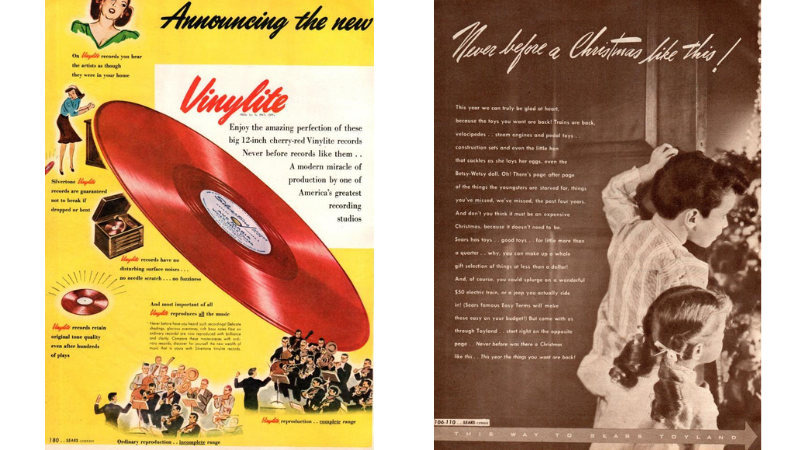
Via Drinks With Broads, this very charming archive of old Sears catalogs. Exactly up my alley and so fascinating! (That $50 “splurge” train-set from 1946 equates to $840 today!)
This lovely article about a man who found his calling in Typewriter Repair, in The New York Times.
I am not against “nepo babies” as a rule—I will stan Carrie Fisher and Laura Dern until I’m in my grave, to name just a few— but paired with entitlement it’s unbearable, and Daphne had that in spades.
Maintaining the uncapitalized style as in the book.
I am extremely pro public transit but even at its best Baltimore’s can be time-consuming.
I have half-thinkingly clicked on stupid Babaa adds for “““one size””” sweaters too many times this winter and am declaring 2026 the year I finish knitting my own.
My favorite book I read this month was of course the bestie’s new release, Mixing Magics. https://app.thestorygraph.com/books/caa6c6eb-119e-42b0-b0aa-4b8a50c07f3c
So Far Gone by Jess Walter is set in the PNW and very much feels like it. Would be interesting to pair it with Educated by Tara Westover.
Cameron Crowe’s new memoir, The Uncool, was really lovely. Very fun seeing the stories that turned into parts of Almost Famous.